


Your startup’s first office: 5 essentials every founder should know
Choosing your first proper workspace is a milestone for any startup. It’s a sign you’re growing, hiring, and committing to bigger goals. But between various lease types, hidden costs, and countless setup decisions, the process can quickly overwhelm even the most organized founders.
Based on insights from supporting hundreds of teams across the Baltics and Finland, here are the five key considerations every startup should evaluate before choosing their first office — along with a few quiet lessons from teams who learned them the hard way.
Practical guidance for early-stage teams (and mistakes worth avoiding)
By Workland
1. How do you know you actually need an office?
In the early stages, many founders ask themselves: “Do we really need an office yet?”It’s a valid question — especially when remote work tools seem to cover almost everything.
Still, there are moments when having a physical workspace becomes not just useful, but necessary.
You’re ready for an office when:
- Your team needs more structure and shared routines
- Collaboration requires more than online calls
- Client or investor meetings would benefit from a professional environment
- Home distractions are impacting focus or productivity
- You’re onboarding new hires who need hands-on support
- You require privacy for product, commercial, or strategic work
- Your team naturally gravitates toward meeting in person anyway
You don’t need an office just because it feels like “the next step.”
You need one when a dedicated environment will help your team work more effectively, collaborate more naturally, and move faster toward your goals.
When the lack of a shared space becomes a barrier — that’s when an office becomes a catalyst.
2. The right workspace must match the way you work
Every team has a rhythm. Some need constant collaboration; others rely on deep focus. Your workspace and the office rent model you choose should fully support your team’s workflow, not push you into a setup that works against it.
Consider:
- Do you need private rooms for calls, product sessions, investor meetings?
- How often does your team collaborate vs. work individually?
- Do you need dedicated desks, or is a hybrid setup enough?
- Are there spaces that allow you to change your working style throughout the day?

3. Flexibility matters more than you think (because growth isn’t linear)
Startups rarely grow in predictable patterns. You might hire three people next quarter — or 15. Traditional leases, long commitments, and rigid terms can become a barrier rather than a base.
Look for flexibility in:
- Contract length
- Ability to scale up or down
- Access to additional meeting rooms
- Options to add team members temporarily (freelancers, temps, interns)
- Entry and exit terms that won’t slow you down
A team signed a three-year lease based on one big contract.
Six months later, the client pivoted.
Suddenly the office became their largest fixed cost — and their biggest headache.
At Workland, we’ve also seen the opposite scenario many times: rapidly growing teams outgrowing their traditional offices long before their lease ends. With new hires joining weekly, the standard office simply couldn’t expand fast enough to accommodate the pace of their growth.
Flexible office solutions allowed them to add space immediately — without renegotiations, renovations, or waiting months for availability.
In the early stages, flexibility isn’t a nice-to-have — it’s a survival strategy. And even as a company grows, flexibility becomes a source of predictability, helping maintain stability as the business evolves.

4. Services and support save more time than they cost
Founders are often surprised by how much operational effort a traditional office rent requires.Before your team writes a single line of code, someone has to sort out:
- cleaning
- WiFi
- utilities
- meeting room technology
- furniture
- repairs
- deliveries
- reception
- kitchen supplies
- waste management
A real lesson:
One founder shared that he spent the first month in their new office setting up routers, assembling desks, and ordering cleaning supplies.
He later joked that his actual job that month was “Head of Office Logistics,” not CEO.
Choosing a workspace with services included frees up time for what actually drives the business.
5. culture, community & atmosphere influence performance more than you expect
A workspace should not only support productivity — it should inspire it.Pay attention to:
- Quality of natural light
- Acoustics
- Interior design
- Sense of community
- Access to events, learning, and connections
- Whether the space energizes or drains people
Lesson learned:
Teams in well-designed, community-driven environments report higher motivation, more collaboration, and faster onboarding.
Teams in isolating or poorly designed offices often feel disconnected before they even grow to 10 people.
Great culture starts with the environment you place your team in.
Final thought: your first office should make building easier, not harder
The perfect workspace is one that:- supports your team’s working style,
- grows with you,
- removes operational hassle, and
- contributes positively to your culture.
Your office shouldn’t be your biggest fixed cost or your biggest distraction.
It should be your foundation — steady, supportive, and ready to grow with you.

__________
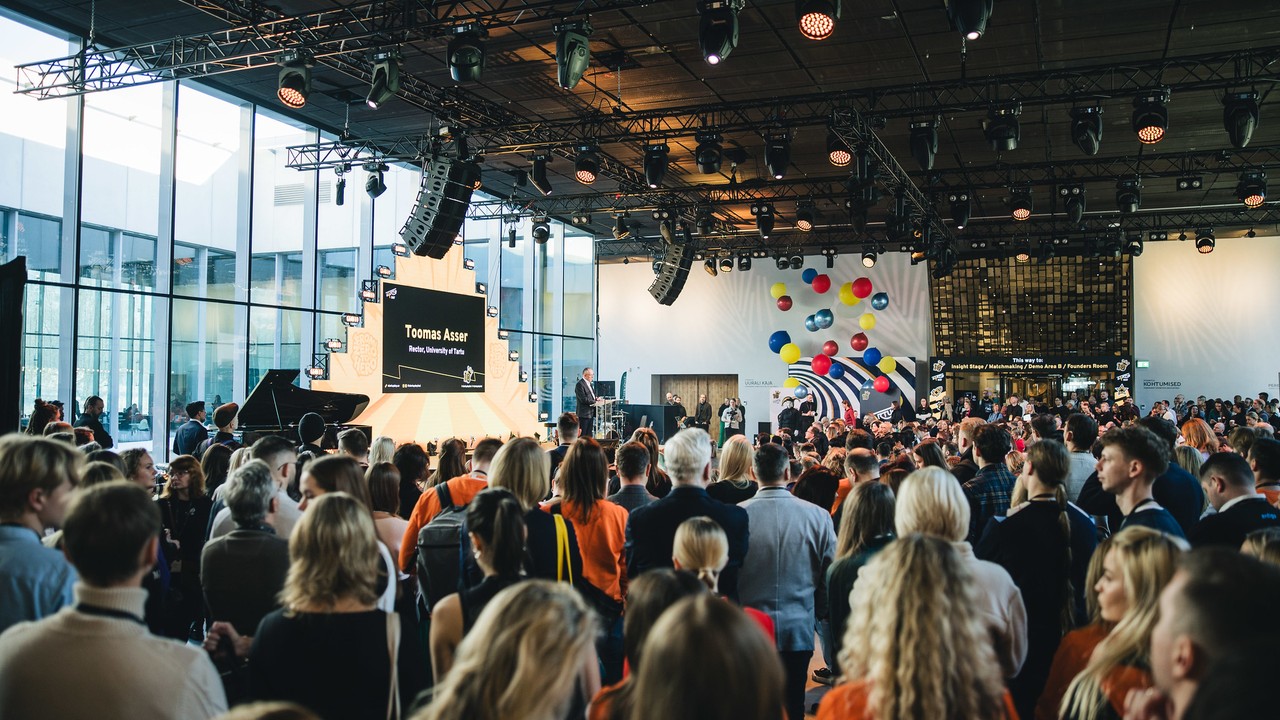
sTARTUp Day is turning 10 – now is the perfect time to grab your ticket at the best price! Join us in Tartu on January 28–30, 2026, for an unforgettable anniversary edition filled with inspiring speakers, valuable connections, and new opportunities. Get your ticket today and be part of the biggest entrepreneurship festival!
Articles you might also like:
Beyond the Day: The New sTARTUp Day
28.09.2026
For the past decade, sTARTUp Day has created a place in Tartu where new ideas, relationships and collaborations can begin. Following its...

How to pitch complex ideas to any investor
19.02.2026
Kerli Luks (Muun Health) and Terje Eichelmann (Lightcode Photonics) discussed one of the hardest problems in fundraising: how to explain highly complex,...